

When Technology Leads… and Thinking Fades
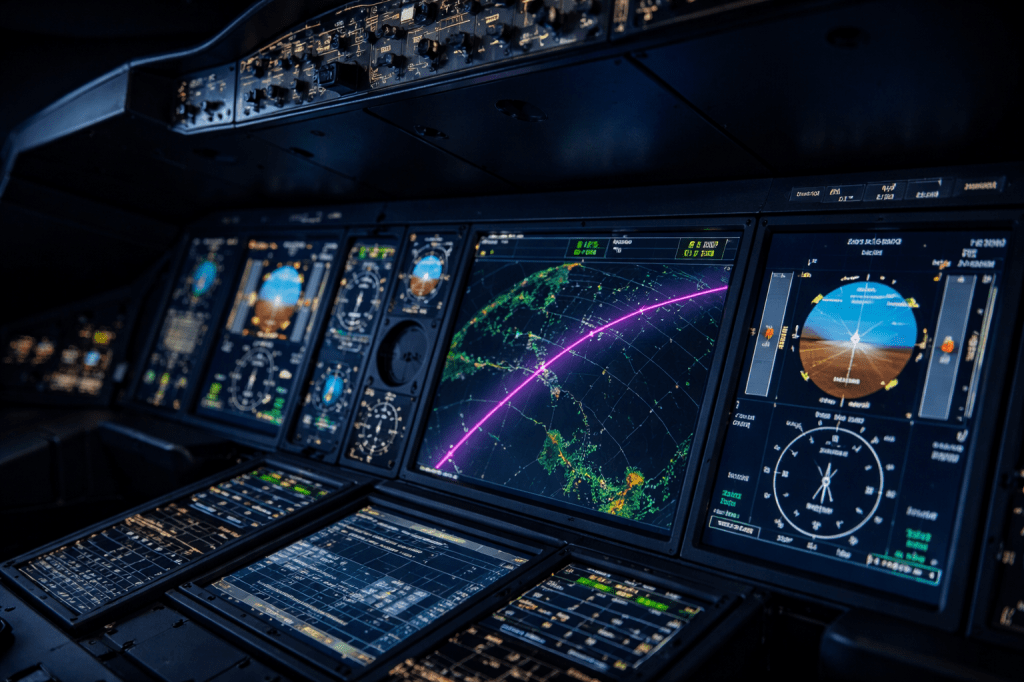
In modern aviation, increasingly characterized by advanced automation and complex interfaces, a term has emerged that is both effective and unsettling: Children of the Magenta Line. This expression refers to pilots who faithfully follow the trajectory indicated by the Flight Management System graphically represented as a magenta line on the navigation display without maintaining a true understanding of the operational situation.
At first glance, this behavior appears efficient: the technology works, the route is respected, and the flight proceeds without deviation. However, what is lost is the pilot’s active role as a conscious decision-maker. The risk does not lie in automation itself, but in the gradual transformation of the operator from an active agent into a passive executor.
From a psychological perspective, this phenomenon can be interpreted through several well-defined constructs. The first is automation bias, which refers to the tendency to excessively trust automated systems, reducing critical monitoring and accepting system outputs as inherently correct. This bias is often accompanied by the complacency effect, a reduction in vigilance that emerges when the system appears to function flawlessly. Under these conditions, attention decreases and active control is progressively abandoned.
A second key concept is cognitive offloading, the process by which individuals delegate part of their cognitive functions to external tools. While this mechanism represents an efficient adaptation — reducing mental workload, when it becomes excessive, it leads to a degradation of internal competencies. The individual not only uses their abilities less, but over time loses the readiness required to reactivate them under critical conditions.
Closely related is the concept of cognitive load. In highly automated environments, cognitive load does not disappear; rather, it shifts from active operation to passive monitoring. This type of load is particularly insidious because it promotes states of reduced vigilance, increasing the risk of losing situational awareness. Situational awareness, defined as the ability to perceive, comprehend, and anticipate the evolution of a situation, is one of the fundamental pillars of aviation safety. When it degrades, the operator loses the ability to maintain an updated mental model of the environment, becoming dependent on system-provided information.
Another important factor is the illusion of competence (overconfidence bias). The correct functioning of automation may be mistakenly attributed to one’s own abilities, generating a sense of control that does not reflect reality. This phenomenon is particularly dangerous because it reduces the tendency to verify, question, and intervene.
These processes also have a meaningful parallel in clinical psychology, particularly in trauma-related and dysregulation models. Under conditions of high stress or traumatic exposure, the nervous system tends to rely on automatic patterns, reducing cognitive flexibility. This aligns with neurobiological models showing decreased activity in the prefrontal cortex responsible for executive control — and increased dominance of automatic survival circuits. In both operational and clinical contexts, a similar dynamic emerges: a loss of agency, where the individual ceases to act as an active subject and becomes an executor of predefined patterns.
Within the framework of Human Factors, the concept of Children of the Magenta Line becomes a powerful synthesis of these dynamics. A safe operator is not one who fully relies on automation, but one who maintains active monitoring a conscious and continuous supervision of the system. This requires the ongoing construction of a mental model of the situation, verification of system outputs, and readiness to intervene flexibly when needed.
In this sense, training cannot be limited to technical skills alone, but must also include the development of core psychological competencies: critical thinking, metacognition (the ability to reflect on one’s own cognitive processes), emotional regulation, and tolerance for uncertainty. The latter is particularly relevant, as the tendency to rely blindly on automation is often driven by the desire to reduce ambiguity and decision-making effort.
From a broader perspective, the phenomenon of Children of the Magenta Line extends beyond aviation and becomes a metaphor for the contemporary human condition. In a world increasingly driven by algorithms, intelligent systems, and automation, the risk is not only operational but existential: the progressive externalization of thinking.
In conclusion, the issue is not technology itself, but how we interact with it. Concepts such as automation bias, cognitive offloading, cognitive load, and loss of situational awareness reveal how easily the human mind can shift toward passive modes of functioning. The challenge today is to preserve the active dimension of thinking — maintaining the ability to understand, anticipate, and decide. Because safety — in aviation as in life — does not depend on the line we follow, but on the awareness with which we choose to follow it.
 Lo Psicologo digitale