

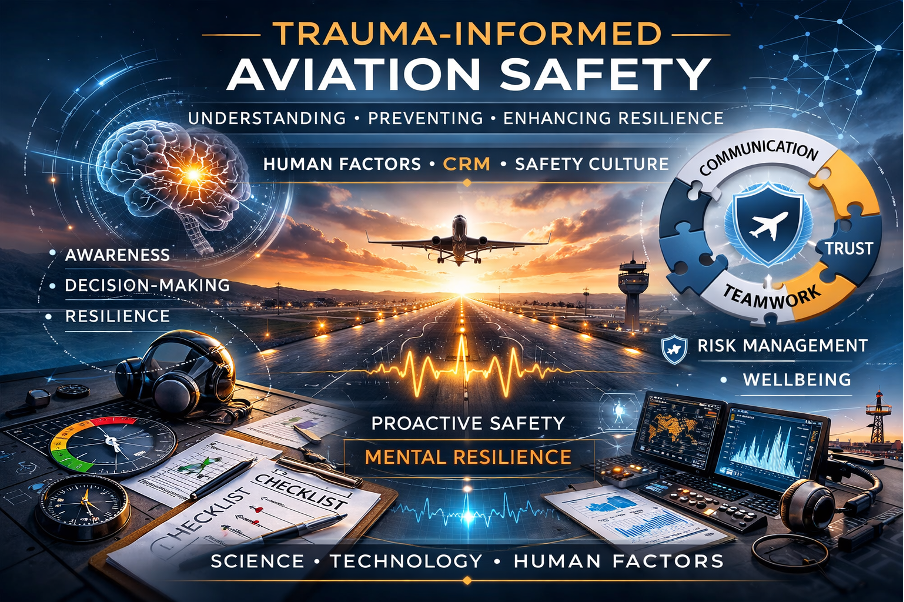
In modern aviation, safety is increasingly the result of a complex balance between technology, procedures, and human behavior. Over the past decades, the introduction of Human Factors, Safety Management Systems (SMS), and Just Cultureprinciples has significantly advanced our understanding of human error. However, there remains a less explored yet highly relevant dimension: the role of trauma-related responses in high-intensity operational environments.
When discussing trauma in aviation, we are not referring only to extreme events such as accidents or major emergencies, but also to repeated exposure to critical situations, high responsibility, constant decision pressure, and complex operational conditions. In these contexts, the human brain does not simply “malfunction”; rather, it activates adaptive responses grounded in neurobiology. The autonomic nervous system, in particular, may trigger states of hyperarousal (fight or flight) or, conversely, hypoarousal (freeze), profoundly influencing perception, information processing, and decision-making.
From a neuropsychological perspective, exposure to acute or chronic stress can temporarily reduce the efficiency of the prefrontal cortex, the area responsible for executive functions, reasoning, and cognitive control. At the same time, increased activation of structures such as the amygdala—central to threat detection and rapid emotional responses—can occur. This imbalance may translate operationally into more rigid decision-making, reduced cognitive flexibility, impaired complex problem-solving, and a tendency toward automatic responses.
In this light, many behaviors traditionally labeled as “human error” can be reinterpreted as manifestations of a system attempting to adapt to perceived critical conditions. For instance, reduced communication, loss of situational awareness, or difficulties in team coordination may reflect emotional overload rather than a mere lack of competence.
Crew Resource Management (CRM) has already introduced essential tools for managing cognitive and relational resources within the crew, emphasizing communication, leadership, and situational awareness. However, a trauma-informed approach represents a further evolution, as it allows us to understand what happens “upstream” of these competencies when operators are under significant stress. Integrating this perspective means developing the ability to recognize early signs of excessive activation, modulate communication load, use silence strategically, and support emotional regulation while maintaining operational effectiveness.
Within modern SMS frameworks, increasing attention is given to the identification of weak signals—early indicators that precede more severe events. A psychological perspective enables the detection of signals often invisible to traditional systems: subtle behavioral changes, decision rigidity, avoidance patterns, reduced initiative, or, conversely, hyper-control. When properly interpreted, these elements can serve as early indicators of unprocessed stress or psychological vulnerability.
Another key component is represented by peer support programs, which have also been introduced at the European regulatory level. Their effectiveness, however, does not depend solely on their formal implementation, but on the quality of the organizational culture in which they are embedded. Environments perceived as judgmental or punitive significantly reduce the likelihood that operators will seek help. In contrast, a culture genuinely oriented toward psychological safety promotes early disclosure of difficulties and enables timely intervention.
Adopting a trauma-informed approach does not mean transforming operational environments into therapeutic settings. Rather, it involves increasing awareness of the human dynamics that influence performance. It requires a shift from an error-centered perspective to an adaptation-centered one, where behavior is understood as the result of an interaction between the individual, the environment, and the psychophysiological state.
Looking ahead, aviation safety is moving toward an increasingly integrated model that combines data, technology, and psychology. Event analysis can no longer be limited to technical reconstruction but must include an understanding of the cognitive and emotional processes that shaped human action. In this context, the aviation psychologist assumes a strategic role, contributing not only to selection and support processes, but also to the design of more resilient systems.
The concept of Trauma-Informed Aviation Safety therefore represents a natural evolution of Human Factors and a necessary perspective for addressing the complexity of high-reliability systems. Understanding how the brain and human behavior respond to stress is not an optional element, but a central component of safety.
Today, true innovation is not only technological. It lies in the ability to integrate the human dimension in a deep, scientific, and operational way—transforming safety from mere error prevention into a genuine understanding of human functioning in complex operational environments.
#AviationSafety #HumanFactors #Trauma #CRM #SafetyManagement #JustCulture
 Lo Psicologo digitale