

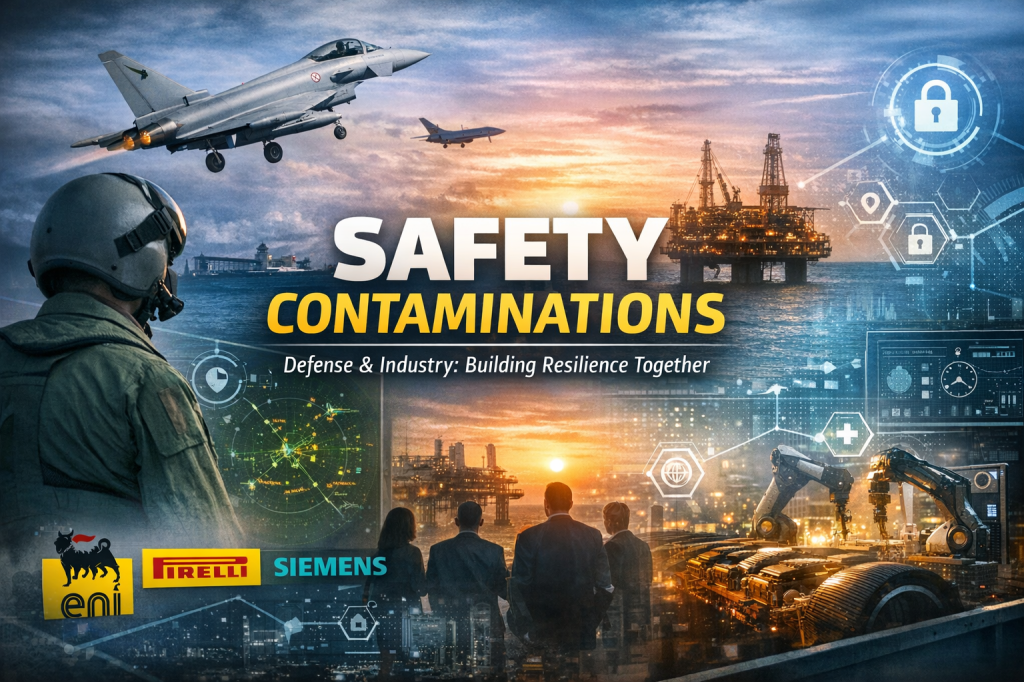
On February 25, 2026, I had the opportunity to take part in the conference “Safety Contaminations,” a high-level dialogue that brought together the Aeronautica Militare Italiana with leading industrial players such as Eni, Pirelli, and Siemens.
The event gained particular depth through the contributions of senior executives operating at the forefront of risk governance: Giovanni Milani, Executive Vice President HSEQ and Chiara Cerruti at ENI; Daniele Deambrogio, CEO of Pirelli, together with Andrea Farzan; and Alberto Croce, Head of EHS at Siemens. Leaders who work daily in highly complex environments where risk management is not merely a regulatory requirement, but a strategic pillar of organizational sustainability.
The title of the conference was especially meaningful. “Contamination” was not framed as overlap, but as deliberate cross-fertilization of cultural and operational models among systems that, although belonging to different sectors — energy, advanced manufacturing, technology, and Defense, share the same fundamental imperative: ensuring reliability where failure is never neutral.
The discussion highlighted a profound convergence between industrial HSEQ/EHS models and the principles underpinning Flight Safety. Proactive prevention, sensitivity to weak signals, procedural discipline combined with adaptive capacity, safety-oriented leadership, and above all the centrality of the Human Factor emerged as shared foundations.
From a Flight Safety perspective, it was particularly significant to observe how methodologies developed within aviation from non-punitive reporting culture to threat and error management are increasingly relevant across complex industrial systems. At the same time, the technological evolution driven by major industrial organizations, including digitalization of processes, advanced monitoring, and predictive analytics, offers tangible opportunities to further strengthen safety frameworks within the aviation domain.
The most evident point of intersection remains the Human Factor. In all these environments, critical events rarely stem from a single technical failure. Rather, they arise from the interaction between decision-making, operational pressure, communication dynamics, leadership, and organizational culture. It is precisely at this intersection that cross-sector contamination generates value: understanding how different organizations structure prevention systems enhances collective resilience.
In an era marked by technological acceleration and increasing systemic interdependence, safety can no longer be conceived as a vertical or isolated function. It must be integrated, shared, and continuously enriched through dialogue between diverse operational realities.
“Safety Contaminations” represented exactly this: a cultural laboratory where Defense and industry demonstrated that they speak the same language, a language of responsibility, methodology, and strategic vision.
Today, safety is not only protection.
It is leadership.
It is resilience.
It is the future.
#safety #safetyculture #riskmanagement #aviation #HSEQ #humanfactor #leadership
 Lo Psicologo digitale