

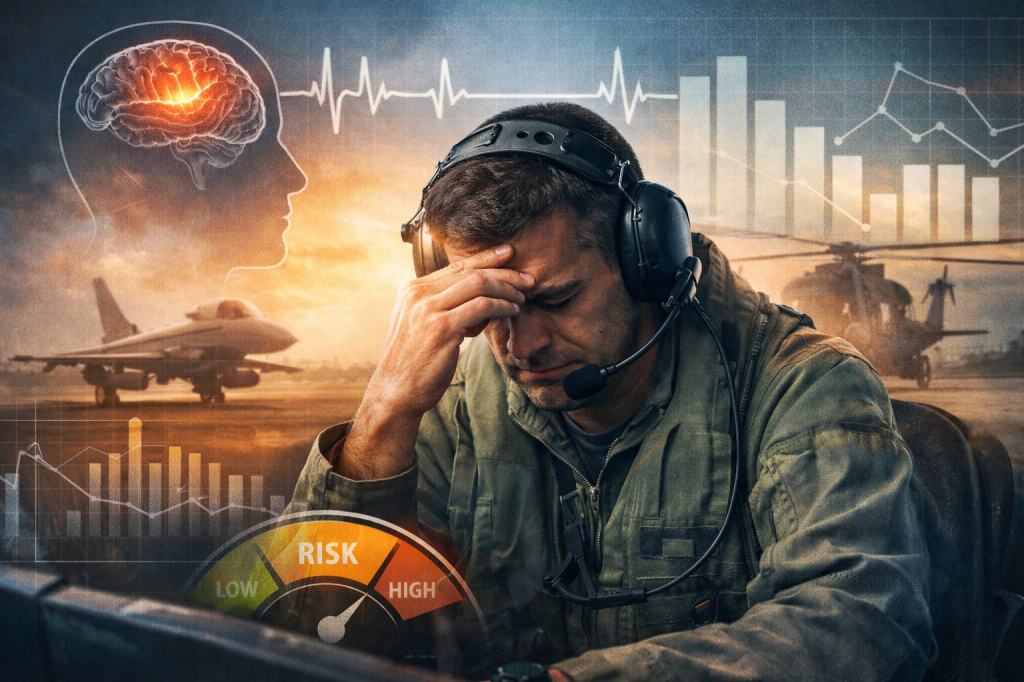
In the aviation domain, flight safety has traditionally been analyzed through technical, procedural, and training-related parameters. However, a significant portion of safety events, including flight accidents, cannot be fully understood without considering the psychological processes that act progressively and often invisibly on the operator. Within this framework, burnout represents a critical variable, not so much in its overt manifestation, but rather in its latent dimension, which can significantly affect performance and risk management.
Latent burnout is neither an acute event nor an easily recognizable condition. From a psychological standpoint, it can be described as a process of gradual psychophysiological depletion, characterized by a reduction in attentional resources, weakening of emotional self-regulation mechanisms, and increasing cognitive rigidity. In operational settings, these changes do not immediately translate into obvious errors or procedural violations; instead, they tend to manifest as attenuating errors, such as micro-deviations, delayed decision-making, reduced anticipatory capacity, and diminished cognitive flexibility.
These errors represent weak but highly informative signals. They indicate that the operator is maintaining performance through compensatory mechanisms typical of experienced professionals, but at the cost of an increasing consumption of cognitive and emotional resources. It is precisely this compensatory ability that makes latent burnout particularly insidious: the pilot continues to function, but with reduced margins, thereby increasing system vulnerability when unexpected events or additional stressors arise.
The relationship between burnout and flight accidents is neither direct nor linear, which is why it is often underestimated. Burnout, in itself, does not cause an accident. Rather, it alters the way the operator perceives, evaluates, and manages risk, reducing the ability to detect critical cues, reorganize priorities under pressure, and adapt flexibly to complex scenarios. In the presence of an anomaly, technical degradation, environmental stressors, or a chain of contributing factors, this reduction in available resources may represent the element that transforms a manageable situation into an accident outcome.
From a flight safety perspective, latent burnout can therefore be interpreted as a systemic vulnerability factor, acting upstream of the event and increasing its likelihood without explicitly appearing in traditional causal chains. It is not uncommon, in post-accident analyses, to identify elements related to chronic fatigue, cognitive overload, organizational pressure, or loss of perceived control, even in the absence of a formal burnout diagnosis.
One of the most critical aspects of latent burnout is its poor subjective detectability. Due to training and experience, pilots tend to normalize fatigue and interpret discomfort as an inherent part of the role. This leads to an underestimation of early warning signs and a reduced tendency to communicate them, particularly in organizational contexts where performance is highly emphasized and error is perceived as unacceptable. Under such conditions, the system loses the opportunity to intercept the problem before it affects safety.
From a preventive standpoint, it becomes essential to understand burnout in its latent phase and integrate it into flight safety interpretative models. This requires a shift in perspective: from errors as individual deviations to errors as indicators of human and organizational load. Attenuating errors, in this sense, do not represent pilot failure, but rather an implicit request for system rebalancing.
Effective prevention therefore requires action on multiple levels. At the individual level, it is necessary to foster metacognitive awareness, enabling pilots to recognize early signs of emotional and cognitive fatigue. At the organizational level, it is crucial to create environments that legitimize the communication of operational discomfort, value qualitative reporting, and promote open dialogue between operators and safety structures. In this perspective, flight safety extends beyond event management to include the long-term psychological sustainability of performance.
In conclusion, latent burnout represents a key element in understanding flight accidents, not as a direct cause, but as a factor that progressively erodes system safety margins. Recognizing it, understanding it, and addressing it in a structured way strengthens organizational preventive capacity and protects not only operational outcomes, but also the human integrity of those who fly.
 Lo Psicologo digitale