

Autistic syndromes are among the most complex and difficult to code diseases. It almost seems that each patient has typical and other purely individual functions.
In fact, a common denominator seems to be the altered perception of reality and in most cases a hypersensitivity or hyposensitivity of both sensory perception and the emotional response associated with the five senses. The “library”, which contains the memory of emotions, resides in the famous “limbic apparatus”, and when it comes to emotions one cannot but speak of empathy.

Generally speaking, empathy is an emotional reaction and variation that we have based on the situation of another living being. This topic was much discussed, especially in contexts related to autism, some of the first studies were conducted by Ascione, deepening the empathy towards humans and animals using a hypothetical example of history. In the story, a child finds a puppy screaming because its paw got caught at the bottom of a mesh fence. To understand the child’s thinking process, we need to ask him about his thoughts and his emotions. In this case, the child must visually identify that a puppy is trapped by the fence, and through a puppy’s screams, the child must know that a puppy is going through a period of distress or fear. The proposed exercise is difficult to apply for children with autism, but possible following the stimulus of empathy and here hippotherapy comes into play.
The Equestrian Rehabilitation starts with the approach to the horse precisely to stimulate empathy and confidence, the calm attitude of the horse provides reassurance for the child who slowly approaches the animal from the ground to above the saddle and then begins the movement. In addition to the physical part, the approach linked to the animal’s needs is fundamental, such as eating (the child will give the horse some feed at the end of the activity) and care, how to brush it before putting it on the saddle. Gestures, modalities and activities primarily shape the cognitive level and the emotional level.
The exercises and the success of the therapy take place only if the child is able to establish a relationship of synergistic empathy, where he himself declares that he wants to see and touch a specific horse rather than another, the relationship is built with mutual trust, where the child cognitively elaborates that the condition above the horse allows a slight continuous, constant and rhythmic undulation, but above all there is an active knowledge that that feeling of stability is provided by the animal and therefore, the amygdala, albeit compromised, associates a stable condition, non-threatening and horse.
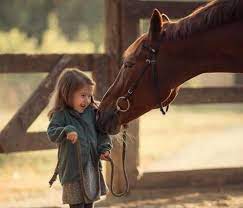
In equestrian rehabilitation, in general, the improvement skills sought are related to motor coordination, postural adaptation, interaction with the animal and communication with the animal, accustoming the “rider” to perform traction or pressure release movements to make the horse perform a task (turn right or left).
The phases implicitly indicate the level of empathy of the child towards the horse and therefore the improved functioning of the functions related to the limbic system.
The basket of events reproposed by the amygdala in similar conditions and a neuronal function governed by the hippocampus allow the child both to make improvements on horseback and to reflect the same in everyday practices, such as during a walk or aboard a train.
Another theory of fundamental importance is that of Bandura’s self-efficacy and the theory of social learning, where children learn socially desirable behaviors through the positive reinforcement of empathic behaviors on the part of family members or friends. In hippotherapy the reinforcement and the therapeutic tool coincide, the child with autistic syndrome by reinforcing this aspect will try to implement adaptation strategies even outside the stables, in contexts that before the imminent influx of sensations prevented an adequate behavioral coding.
Article Written by Pierangelo Valaperta
 Lo Psicologo digitale